

What stretches should you do after a massage in Arcachon? The complete routine explained by our physical therapists
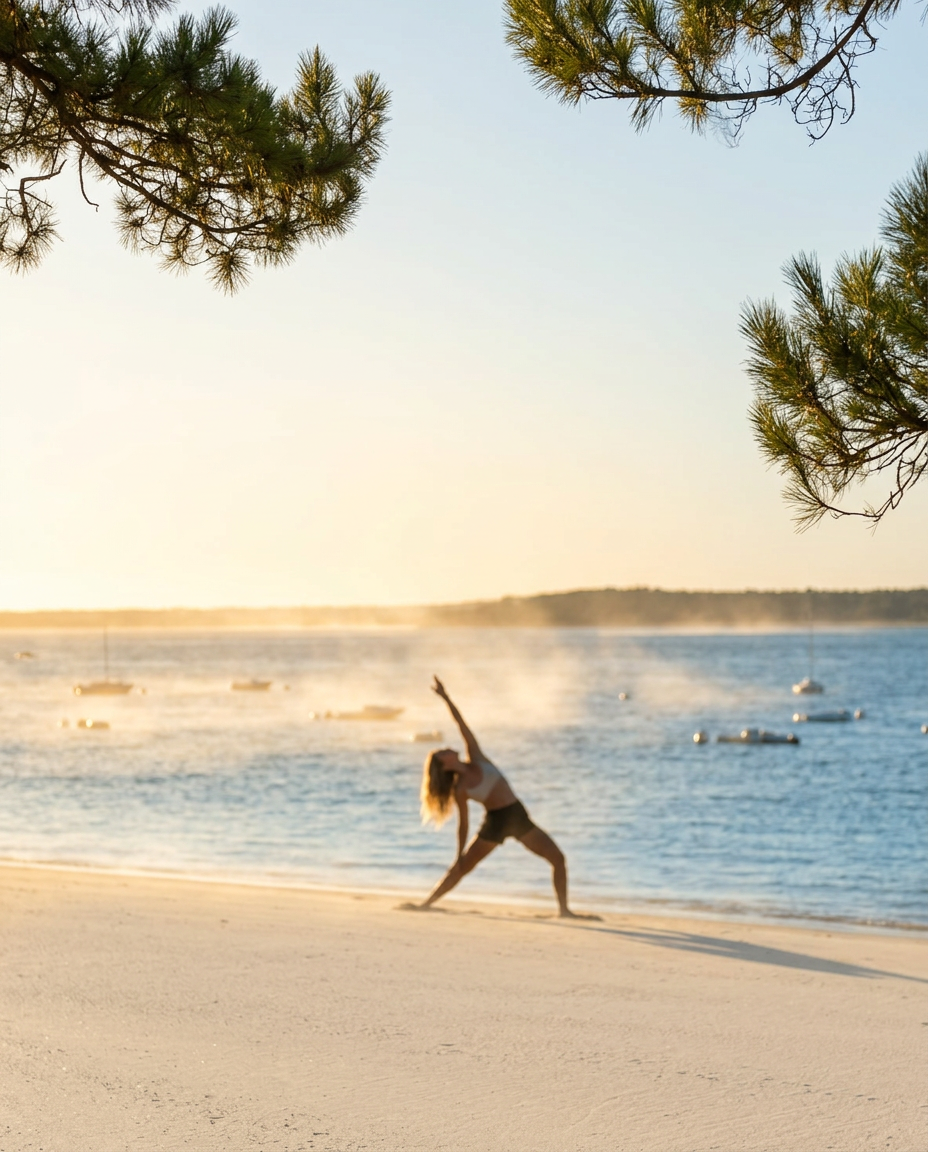
“What can I do at home to prolong the effects of the massage?” This is one of the most common questions asked of our practitioners at the end of a session at our Arcachon spa. Our answer comes down to a short routine that we consistently recommend during the post-session debrief: a series of stretches that—and this is no coincidence—corresponds almost exactly to a millennia-old yoga sequence—the Sun Salutation (Surya Namaskar). This is no coincidence: this sequence was originally designed to engage the entire body in a balanced way in a minimum amount of time, making it a particularly well-suited tool for extending the benefits of a massage far beyond its traditional context.
This article explains why this specific sequence targets the right areas of the body after a massage in Arcachon, how to perform it step by step with visual guides for each pose, and what physiology tells us about its duration, frequency, and the best time of day to do it.
Why Stretch After a Massage in Arcachon? What Physiology Tells Us
A massage is not a one-time event: what happens in the hours following the session largely determines how long its effects will last. Stretching is not just a pleasant add-on—it plays a specific physiological role in extending the benefits of the practitioner’s work.
Massage releases the fascia; stretching prolongs the effect
Fascia are membranes of connective tissue that envelop muscles, organs, and joints, forming a continuous network throughout the body—to the point that researchers in functional anatomy now refer to “myofascial chains” rather than isolated muscles. The hands-on work of massage reduces adhesions and tension accumulated in this fascial network, locally loosening areas that had lost mobility—sometimes as a result of months or years of repetitive posture.
But this release is temporary if the body immediately reverts to its usual postural patterns: without actively engaging the newly regained range of motion, the tissues tend to gradually return to their initial state of tension—a phenomenon that physical therapists commonly observe in people who space out their sessions too far apart without ever moving in the meantime. Stretching, on the other hand, when performed within the following hours, allows one to take advantage of this window of greater fascial mobility to consolidate the increased range of motion achieved during the session—a principle similar to the one that guides traditional physical therapy rehabilitation: an isolated manual maneuver is always more effective when followed by active mobilization by the patient themselves.
Blood and Lymphatic Circulation: Why You Should Move Right Afterward
Massage stimulates blood and lymphatic circulation in the treated areas, promoting the elimination of metabolic waste accumulated in the tissues—a process that, at Beroa, is enhanced by a systematic visit to the hammam before the treatment, which already prepares the microcirculation. Gentle, active movement—such as a series of stretches—prolongs this effect by engaging the muscle pump, which actively contributes to return circulation, particularly lymphatic circulation—a system that, unlike the bloodstream, has no pump of its own and relies entirely on the contraction of surrounding muscles to move forward. Conversely, prolonged inactivity immediately after a massage (such as sitting for a long time in a car or in front of a screen) slows this process and delays the elimination of released tension, which explains why some clients experience stiffness at the end of the day if they haven’t moved around after their treatment.
Proprioception and Postural Repositioning
Massage temporarily alters the body’s perception of itself—what neurophysiologists call proprioception, that is, the nervous system’s ability to constantly track the position of various body parts without needing to look at them. This heightened awareness, immediately following a session, provides a particularly favorable opportunity to retrain the body to achieve greater ranges of motion and better postural alignment: the proprioceptive sensors located in the muscles and tendons, which are momentarily more sensitive after manual manipulation, transmit more precise information about the actual condition of the tissues. A stretching sequence performed at this time therefore also serves as a period of postural retraining, rather than merely as a simple muscle-stretching exercise—this is how our practitioners frame it during the debrief: less as a prescription and more as an opportunity to be seized while the body’s sensitivity remains heightened.
Before or after exercise? When is the best time to stretch?
Post-massage stretching vs. post-workout stretching: two different approaches
It is important to distinguish between two contexts that are often confused. After intense physical exertion, prolonged static stretching while muscles are still warm is now discouraged by the sports physiology literature, as it can interfere with ongoing muscle micro-repair and, in some cases, temporarily reduce available muscle strength. This is actually a point we address differently for our athletic clients during recovery massages after a bike ride, a run, or a surfing session on the Bassin, where the post-session advice differs slightly.
After a relaxation or comfort massage, the approach is different: there are no micro-tears in the muscles that need to be protected, but rather relaxed tissues and temporarily increased joint mobility that should, on the contrary, be actively utilized. The sequence recommended here is therefore not a sports recovery stretch, but a gentle mobility routine to be performed without straining, as a direct extension of the relaxation achieved during the treatment.
The best time of day to do this exercise
While it is best performed immediately after a massage, the sequence can be done at any time of day, depending on the time of the appointment—the window of fascial and proprioceptive mobility mentioned above lasts several hours, which allows plenty of flexibility to incorporate it without any constraints, whether the treatment took place in the morning or late afternoon.
Outside of this context, and if you’d like to incorporate it as a regular routine separate from a massage, first thing in the morning remains the best time: the body, which hasn’t yet been put under much strain, fully benefits from the joint mobilization and circulation-boosting effects unique to this sequence—which, incidentally, is called the “Sun Salutation” in reference to its traditional practice at dawn. In the evening, a slower version that omits the most dynamic poses (plank, lunge) can also promote relaxation before bedtime, but this is not the approach we primarily recommend after a massage, where the goal remains active mobilization rather than pure relaxation—which has already been largely achieved during the session itself.
Sun Salutation: A Complete Circuit Sequence
The concept of a loop: a sequence that returns to its starting point
What makes this sequence particularly well-suited for use after a massage is its closed-loop structure: it begins with a neutral standing posture, moves through a series of positions that successively mobilize the front of the body, the back of the body, the hips, and the spine, and then returns exactly to the starting posture. This return to the starting point is significant: it ensures that the body finishes the sequence in a symmetrical and balanced state, with no one area overworked relative to another. It is this circuit-based approach—rather than a collection of isolated stretches disconnected from one another—that makes it a coherent routine that can be recommended almost as is.
What the sequence conveys
Throughout the entire circuit, the sequence targets, in the following order: the posterior chain (calves, hamstrings, lower back) during forward bends, the anterior chain (psoas, quadriceps, abdominals) during cobra-style extensions, the hips during lunges, and the entire spine through alternating flexions and extensions. It is precisely this broad and balanced coverage that explains why this sequence so extensively overlaps with the areas our practitioners target in their post-massage stretching recommendations, regardless of the type of massage received.
The Step-by-Step Process
Each pose is held for 3 to 5 full breaths (about 15 to 20 seconds), in a fluid, smooth motion—the goal is not performance, but the gentle mobilization of tissues that have been relaxed by the massage.
1. Prayer Pose (Pranamasana)
Stand with your feet together and your hands clasped in front of your sternum. This starting posture is not merely a gathering point: it establishes the breathing rhythm that will guide the entire sequence and serves as a physical reference point—this is where the sequence will begin and end. Take three breaths before beginning the first movement, to allow the body to emerge from the state of stillness it was in on the massage table.
2. Raised-Arm Stretch (Hasta Uttanasana)
Inhale as you raise your arms above your head, arching your back slightly, with your gaze following the movement of your hands. This extension stretches the anterior trunk chain—the rectus abdominis and intercostal muscles—and opens the rib cage, as a direct extension of the work done on the back during the massage. It is also the pose that most directly engages the shoulders, an area where most of the tension associated with computer work accumulates.
3. Forward Bend (Uttanasana)
Exhale as you bend your torso forward from the hips, with your hands toward the floor or your shins, and your knees slightly bent if your hamstrings are tight—never force the range of motion. This pose stretches the entire posterior chain: calves, hamstrings, and lumbar fascia. This is an area that is almost always addressed during a back or leg massage, and one where the relaxation achieved during the session is most quickly reversed without active movement.
4. Low Lunge (Ashwa Sanchalanasana)
One leg extended backward, knee on the ground; the other leg bent at a right angle in front, with hands resting on either side of the front foot or raised toward the sky for a more intense variation. This pose deeply stretches the hip flexor (psoas) of the back leg—a muscle that is almost always shortened by prolonged sitting and rarely engaged in everyday movements.
5. Plank (Phalakasana)
Both legs move back, the body aligned from head to heels, with the hands placed directly beneath the shoulders. This pose engages the deep abdominal muscles and shoulder stabilizers without significant stretching: it serves as a transitional pose and a brief core-strengthening exercise between the opening phases that frame it, and reminds the body of its midline before moving into a new extension.
6. Eight-Point Salute
Knees, chest, and forehead on the floor, pelvis slightly raised, elbows close to the body. This transitional pose, held briefly, allows you to relax your shoulders for a moment and gently prepare for the lumbar extension that follows—it prevents a transition that is too abrupt between Plank and Cobra.
7. Cobra or Upward-Facing Dog (Bhujangasana / Urdhva Mukha Svanasana)
Upright torso in extension, pelvis close to or lifted off the floor depending on your comfortable range of motion, elbows slightly bent to avoid locking the joints. This posture stretches the entire anterior trunk chain and directly counteracts the hunched posture that many people adopt daily while sitting in front of a screen—it is often the posture most recommended by our practitioners after a massage targeting the neck and upper back.
8. Downward-Facing Dog (Adho Mukha Svanasana)
Keep your pelvis high, your body forming an inverted triangle, your heels gently seeking the floor without straining, and your head relaxed between your arms. This pose simultaneously stretches your calves, hamstrings, and shoulders, while promoting gentle venous return thanks to the position of your head below the level of your heart—a particularly welcome effect after a leg massage.
9. Low lunge, opposite leg
Same posture as in Step 4, but with the opposite leg, to symmetrically balance the hip-opening work on both sides of the body. It is this systematic symmetry—unique to the circuit structure—that distinguishes the sequence from a simple series of randomly chosen stretches.
10. Forward Bend (Return)
Return to the position from Step 3, with both legs together, to symmetrically complete the work on the posterior chain.
11. Arm-Raised Stretch (Reverse)
Return to the position from Step 2, straightening up gradually, vertebra by vertebra, rather than in a single movement—it is this slow progression that protects the lower back and prolongs the feeling of a stretch in the anterior chain.
12. Prayer Posture (Back to the Starting Point)
The sequence ends exactly where it began, with your hands pressed together in front of your sternum. It is this precise return to the starting position that marks the end of a complete cycle and allows you to move seamlessly into the next cycle without breaking your rhythm if you perform several in a row.
How many repetitions, how long, and how often?
A complete cycle, performed at a slow, measured pace, lasts about 1 to 2 minutes. For use after a massage, we recommend 3 to 5 cycles, for a total practice time of 5 to 8 minutes —enough to mobilize all the areas that were worked on, without overdoing it and putting strain on tissues that primarily need active rest, not exertion. As part of a regular routine independent of massage, 3 cycles upon waking, a few times a week, are sufficient to maintain overall mobility without causing muscle fatigue.
It is not necessary to increase the number of cycles over time to reap the benefits: unlike strength training, where progress depends on increasing the load, the value of this sequence lies primarily in its regularity. Performing three cycles consistently after each massage produces a more pronounced effect over time than occasional, longer sessions.
Our Practical Tips
Never force your range of motion. The goal after a massage is to gently mobilize the body, not to achieve a perfect posture; reduce the range of motion in your lunge or forward bend if you feel any tension.
Breathe through each transition. Inhale during opening poses (raised arms, cobra), and exhale during forward-bending poses (forward bend, downward-facing dog)—this breathing rhythm enhances the desired muscle relaxation.
Adjust the exercises based on the area that was massaged. If the massage focused specifically on the lower back or legs, you can place more emphasis on forward bends and Downward-Facing Dog; if the massage targeted the shoulders and neck, focus on the raised-arm stretch and Cobra pose.
Avoid this sequence if you have any known contraindications (uncontrolled high blood pressure, acute lower back pain, pregnancy), and consult your practitioner: they can adapt the poses or suggest a more targeted alternative.
Extend the benefits of your next massage
This sequence, which our certified physical therapists regularly recommend at the end of a session, is a natural extension of the work done during your massage in Arcachon. To understand in more detail the physiological mechanisms at work during a treatment—the nervous system, circulation, and tissue recovery—you can read our article on what science says about natural therapies. And to book your next session at our Arcachon spa and leave with personalized advice, check our availability online.